Trying to choose between a condo or a townhome in Jacksonville Beach? You are not alone. Both offer a lock-and-leave lifestyle near the ocean, but the details can change your costs, your insurance, and your day-to-day life. In this guide, you will see how ownership, maintenance, insurance, and financing differ, plus a practical checklist to help you buy with confidence. Let’s dive in.
Ownership shapes everything
The legal form of ownership is the starting point. In Florida, most condos fall under Chapter 718, where you own the interior of your unit and share the building’s exterior and common elements with other owners through the association. A townhome can be fee-simple under Chapter 720, where you own the unit and the land it sits on, or it can be structured like a condo under Chapter 718. The term “townhome” in marketing does not guarantee fee-simple ownership, so verify the recorded documents before you fall in love with the floor plan.
What to check in the documents:
- The recorded declaration and bylaws for a condo, or CC&Rs for an HOA.
- The plat or legal description to see if you own the lot and yard.
- Rules for rentals, pets, parking, and structural changes.
What HOA fees cover
Condo fees tend to be higher on average because the association usually maintains and insures the building’s exterior, roof, and common systems. These fees also fund reserves for long-term projects like roof replacement, structural repairs, and elevator upkeep. Amenities, shared utilities, and security can add to the monthly amount.
Townhome HOA dues vary. In fee-simple communities, you often take care of your own exterior, roof, and yard, so dues may be lower and focused on common areas and amenities. Some townhome HOAs still handle exterior painting or roof work for uniformity. Always confirm what the dues include and what they do not.
Fee drivers to watch:
- Building age, number of units, and presence of elevators and parking structures.
- Salt-air exposure, hurricane hardening, and deferred maintenance.
- Scope of amenities and shared utilities.
Insurance and flood basics
Your insurance needs mirror your ownership. Condo owners usually carry an HO-6 policy for interior finishes and personal property, while the association carries a master policy for the building and common areas. Fee-simple townhome owners typically need a full homeowners policy, such as HO-3 or HO-5, that covers the entire structure and liability.
In Florida, windstorm deductibles are often a percentage of the dwelling coverage, and flood insurance is a separate policy. If the property is in a FEMA-designated high-risk flood zone, a lender will require flood insurance. Review the association’s master policy carefully to learn whether wind or flood coverage is included, the limits, and how deductibles might be passed to owners through assessments.
Jacksonville Beach coastal factors
Coastal living brings specific maintenance and risk considerations. Salt air and humidity speed up corrosion of metal railings, door hardware, and HVAC components. Sand and airborne salt can shorten the life of windows and sliding doors. These factors increase the need for frequent exterior care and stronger reserves.
Elevation matters near the ocean. Ask for any elevation certificates and flood claim history. Building age and construction type also affect durability and insurance costs. Concrete structures and newer roofs can improve wind resistance, but you should confirm inspection and maintenance records to understand the true condition.
Financing and resale reality
Condos can face stricter lender review. Lenders look at the association’s budget, reserves, insurance, and any litigation, and some projects do not qualify for certain government-backed loans unless they are approved. This can narrow the buyer pool and affect resale.
Fee-simple townhomes are often simpler for lenders because the loan focuses more on your unit and less on project-level eligibility. That said, marketability still depends on the property’s condition, reasonable dues, and clear rental policies. Associations that maintain strong reserves and transparent maintenance plans tend to support better resale outcomes.
Lifestyle tradeoffs to weigh
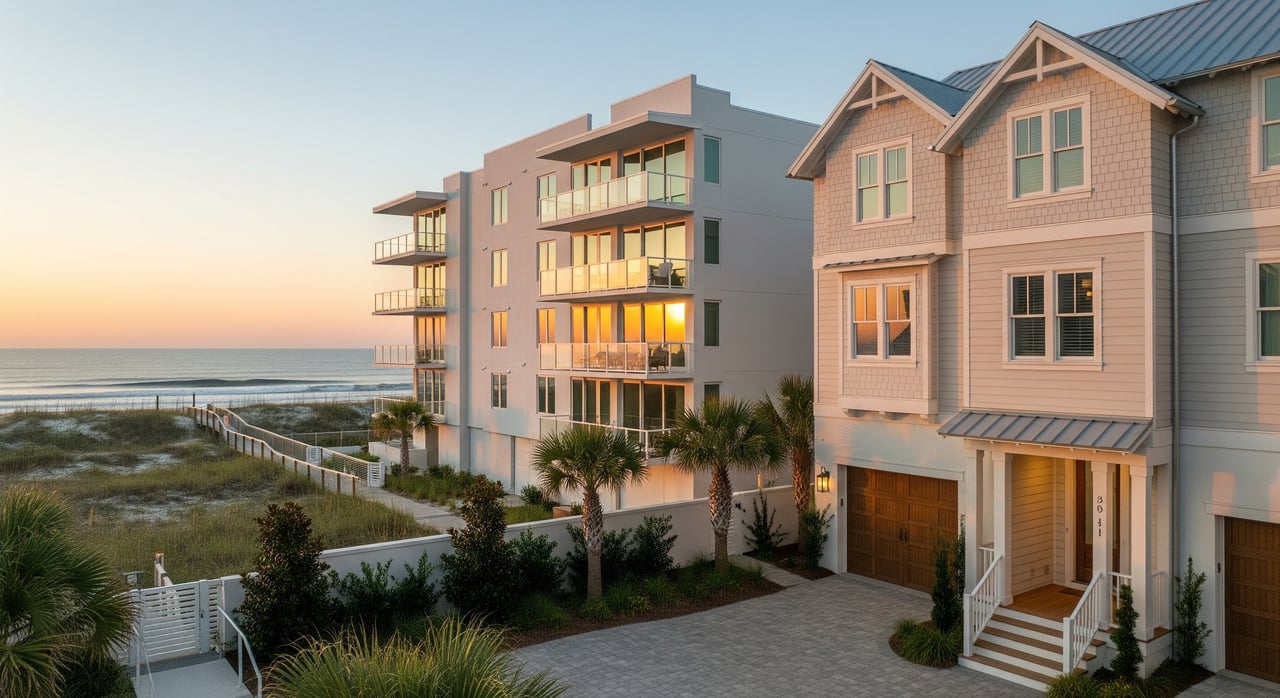
Condos often offer a lighter maintenance load and shared amenities, which can be ideal if you want a turnkey setup near the beach. You will likely pay higher monthly dues and follow stricter rules, but you trade that for convenience and staff-managed upkeep.
Townhomes often give you more control over your exterior and yard, which many owners prefer. You may carry more responsibility for maintenance and insurance, and dues may be lower depending on how much the HOA covers. Your decision comes down to how hands-on you want to be.
Which option fits you
Consider these quick scenarios:
- Choose a condo if you value minimal exterior responsibilities, on-site amenities, and a lock-and-leave lifestyle.
- Choose a fee-simple townhome if you want more privacy, control over your exterior, and the ability to manage maintenance on your timeline.
- Consider a townhome built as a condo if you want the townhome feel but prefer association-managed exteriors. Verify the legal form first.
Buyer due diligence checklist
Documents to request
- Declaration and bylaws for condos, or CC&Rs and bylaws for HOAs.
- Current budget, recent financial statements, and reserve study.
- Board meeting minutes for the last 12 months or more.
- Current dues, any pending special assessments, and a 5–10 year assessment history.
- Master insurance policy declarations and unit-owner insurance requirements.
- Recent building inspections, engineering reports, and maintenance plans.
- Litigation disclosures and management company details.
- Records of roof, siding, elevator, and shared-system repairs or replacements.
- Flood claim history and any elevation certificate.
Questions to ask
- Is the property a condo or fee-simple townhome?
- Who maintains the roof, exterior walls, windows, decks, and driveways?
- What is included in monthly dues, and how much is in reserves?
- Are there pending special assessments or major projects in the next 1–5 years?
- Have there been wind, flood, or structural insurance claims recently?
- Have there been any required inspections or recertifications, and what were the results?
- What are the rental policies, including short-term rules?
- What are typical utility costs, and who pays which utilities?
- For condos, what percentage of units are non-owner-occupied?
Inspection priorities near the coast
- Roof age, condition, and drainage.
- Exterior envelope, balconies, railings, and waterproofing.
- Corrosion on metal components, HVAC condensers, and electrical panels.
- Window and door seals, especially sliding doors.
- Signs of past water intrusion, rot, or mold.
- Elevation relative to base flood elevation and any flood mitigation.
Red flags to pause on
- Inadequate reserves for the building’s age and coastal exposure.
- Recurring or large special assessments for structure or envelope repairs.
- Ongoing litigation related to structural integrity or insurance disputes.
- Master policies with high deductibles that could be assessed to owners after a storm.
- Unclear responsibility for coastal protection features or flood mitigation.
Work with trusted advisors
Choosing between a condo or townhome in Jacksonville Beach is about balancing lifestyle with risk and cost. The right fit depends on how you want to live, how much maintenance you want to manage, and how the association is run. With strong documents, clear reserves, and the right insurance, either path can work well by the ocean.
If you want a seasoned, detail-focused team to help you evaluate associations, review building reports, and compare options, connect with Jeanie & Joe. You will get thoughtful guidance, technical insight, and a smooth, client-first process.
FAQs
What is the key difference between a condo and a townhome?
- Condos typically involve owning the interior while the association owns and maintains the exterior and common areas; fee-simple townhomes usually include ownership of the structure and land, with the owner handling most exterior maintenance.
Do lenders treat condos differently from townhomes?
- Yes. Condos often undergo project-level lender review for reserves, budgets, insurance, and eligibility, while fee-simple townhomes usually face simpler underwriting focused on the individual property.
What insurance will I need near the ocean?
- Condo owners usually carry an HO-6 policy plus rely on the association’s master policy; fee-simple townhome owners typically carry an HO-3 or HO-5 policy. Flood insurance is separate and may be required in high-risk zones.
Are condo fees always higher than townhome dues?
- Not always, but condo fees are often higher because they fund building insurance, exterior maintenance, major system reserves, and amenities. Townhome dues vary based on how much exterior work the HOA covers.
How do flood zones affect buying in Jacksonville Beach?
- Properties in high-risk FEMA flood zones usually require flood insurance for mortgages. Elevation certificates and past flood claim history help you and your lender evaluate risk and premiums.
What documents should I review before making an offer?
- Request governing documents, budgets, financials, reserve studies, meeting minutes, insurance declarations, inspection and engineering reports, assessment history, litigation disclosures, and maintenance records.